Part of my recovery after tibias surgery is to wear these splints 22 hours/day.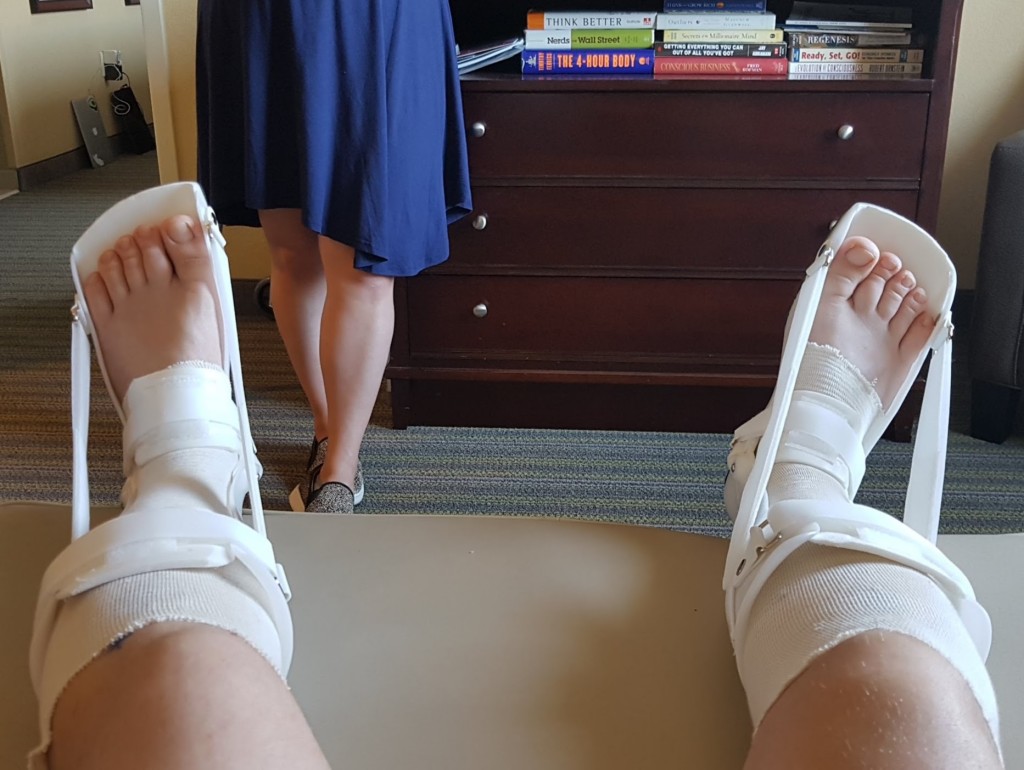
Needless to say, they're extremely uncomfortable, and I can barely get an hour or two of sleep in them.
1. Which doctors who do tibias recommend these types of splints?
2. If the patient can hardly tolerate splints, what options are there for correcting ballerina foot and how long do they take? In other words, can one make peace of mind with sleeping without the splints, knowing they'll have to spend X weeks doing extra PT to correct drop foot? I'm trying to figure out if it's theoretically worth giving up on trying to sleep with the splints, and instead getting some quality sleep (hence better healing and mood during recovery).
("theoretically" because I'm doing femurs at the same time and can only *try to* "sleep" on my back anyway).
Found some related discussion, and this patient who ditched the splints, but wanted to see if others had more experience.
Preventing ballerina with splints (dorsiflexion boots) vs. fixing ballerina
Oh, that looks uncomfortable... 
I wonder if this is better to sleep with:
https://www.amazon.com/gp/product/B0057M3TWC/ref=as_li_ss_tl?ie=UTF8&camp=1789&creative=390957&creativeASIN=B0057M3TWC&linkCode=as2&tag=plantfascires-20
Does someone know if ankle splinta are used even with LON?
If LON does not require them, I wonder why with precise.
you always use some way to prevent ballerina during tibia LL
If you start walking bf will be reduced in a few months.
Those splints is not the best solution but they are better than nothing.
The only thing noone should ever done to fix bf is atl surgery and generally any surgery (even gastrocnemius recession).
Walking is the best solution but still some bf could remain forever. This is not a big deal as with shoes and some lifts on you'll be completely ok.
So, avoid any surgery for fixing bf. Try simple solutions and in most cases bf will be gone completely.
Quote from: chibi on April 14, 2018, 12:46:03 PMI wonder if this is better to sleep with:
https://www.amazon.com/gp/product/B0057M3TWC
I bought a very similar item, https://www.dme-direct.com/medspec-phantom-dorsal-night-splint, and it was actually worse. I'm looking at trying a few others:
https://www.dme-direct.com/aircast-dorsal-night-splint
https://www.dme-direct.com/ovation-medical-dorsal-night-splint
https://www.dme-direct.com/shop-by-product/foot-braces-brace/foot-drop-braces-brace/deroyal-pediatric-ankle-contracture-boot
http://www.docortho.com/pro-tec-night-splint.html
Dr Rozbruch's wrote in 2014, I wonder if ankle splints started to be used after this article;
Physiotherapy is instituted for tibial
lengthening, with a focus on ankle
dorsiflexion and knee extension.
The patient wears an ankle dorsiflexion
split during the day and
a knee extension brace at night. For
femoral lengthening, physiotherapy
focuses on knee flexion/extension
and hip extension.
https://www.reachyourheight.com/wp-content/uploads/2017/12/2014-Rozbruch-Birch-Dahl-Herzenberg-Internal-Lengthening-Devices-Journal-of-the-American-Academy-of-Orthopedic-Surgeons.pdf
Knee brace looks even more annoying than ankle splint..
https://www.dme-direct.com/3x10-0-full-knee-extension-board
Delete
OK, so after walking (with a walker, then cane, then unassisted) for the past 3.5 months since I stopped lengthening, I can say that walking weight-bearing (and having stopped lengthening, of course) has been far more effective at improving the dorsiflexion angle than PT.
So yes, I would advise wearing the dorsiflexion boots as much as you can, but "don't lose sleep over it". If you can't stand them, take them off. Once you can walk, your ankles will recover faster.
Of course, this is only my experience, and I've only lengthened 3.5cm in the tibias. The more you lengthen, the more you should wear those boots!
You must be logged in to post a reply.